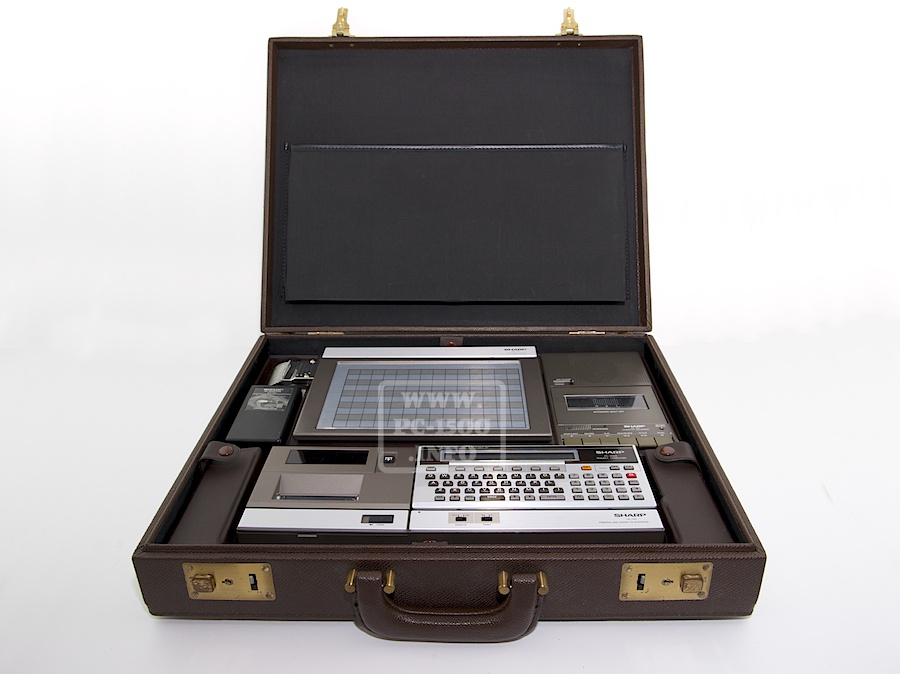
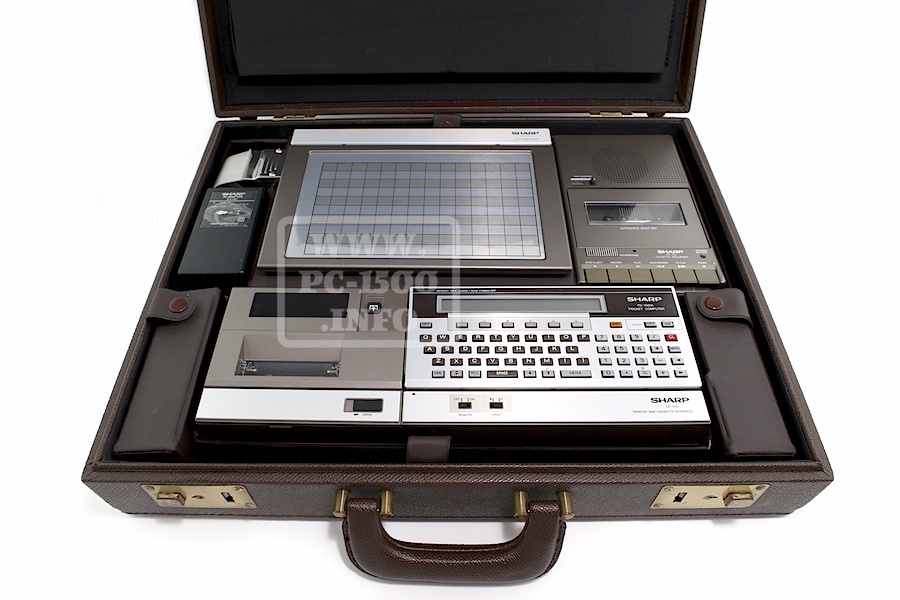
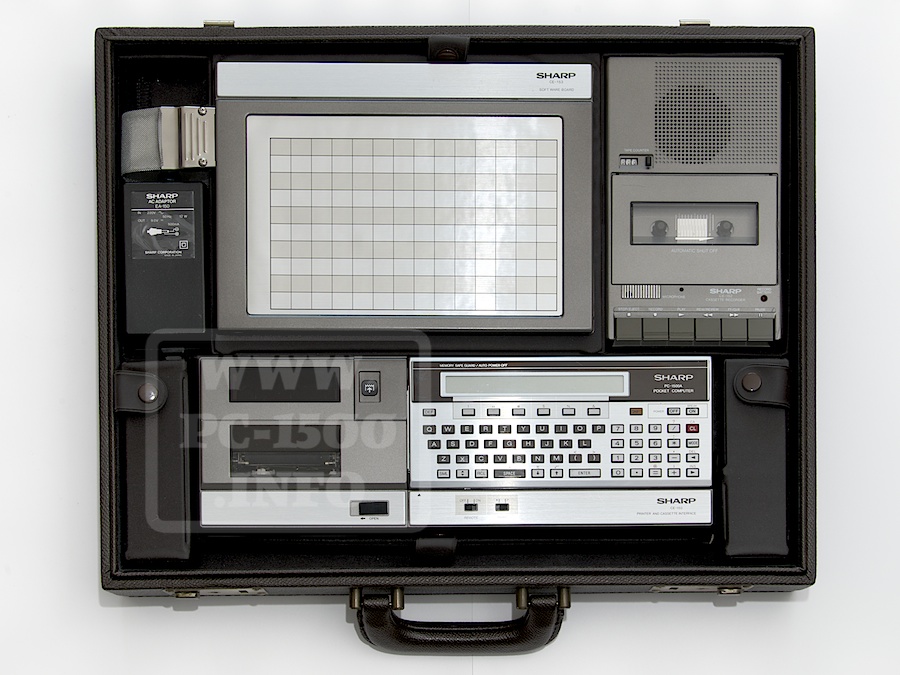
I’m proud to present a french friend : Christophe known as “CGH”
– Christophe, can you tell us some words about you ?
Christophe, 50 years old, computer engineer, working on ARM and PowerPC targets running Real-Time Embedded Linux systems for Telecom software development.
I discovered the “computer world” in june 1980 when I received a TI-58. So, my first steps were the TI-58 language, close to the assembler.
After, I bought a Texas TMS169/199, a single board computer, where I play a little with the University BASIC, but also with UNIBUG monitor. I say that I really learn assembler with it. This was in middle of 1981.
– Where, when, why your PC-1500 ?
The PC-1500 comes in the last days of december 1982. I chose the PC-1500 for the unique reason that the assembler was accessible and also some french magazines (L’Ordinateur Individuel, L’Ordinateur de Poche) were speaking about the first MCODE discoveries. After I became a member of the SHARPENTIERS and I also got access to some TRACE reviews, thanks to a schoold friend who owned a TANDY PC-2.
I always said, that I never really used the embedded BASIC. I only worked in machine language on my PC-1500. I have bought the PC-MACRO software with its monitor PC-HEX, and after I discovered the BEST of ALL: XMON written by Philippe GAC. Today, 30 years later, I own several PC-1500, and all have a XMON image inside.
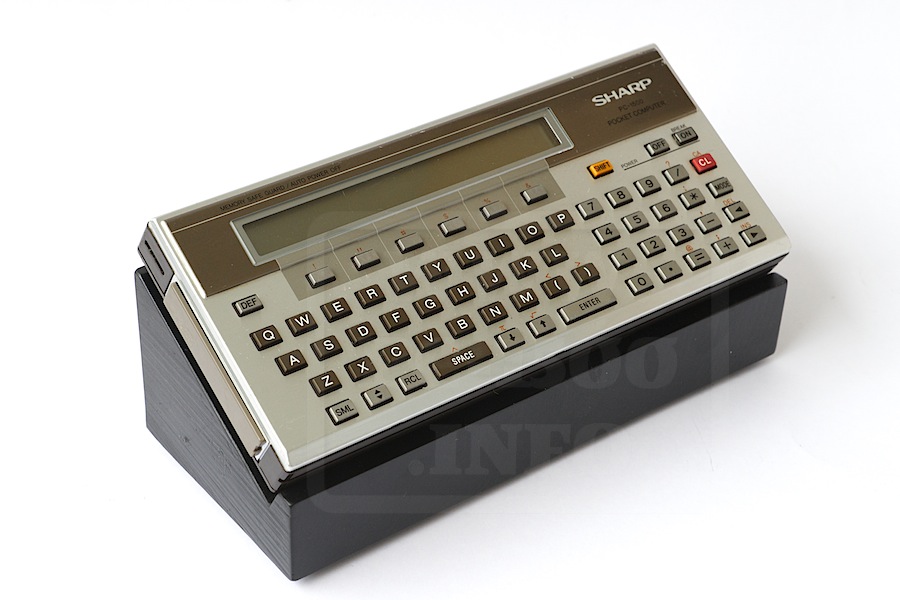
On my view, I believe that the PC-1500 was really the best pocket computer ever built. Graphic, Music, powerful BASIC, assembly access, … and now, fully documented and of course, a very great built quality.
– Our friend Emmanuel is hosting some of your freeware tools on his historical website www.PC1500.com. Can you tell us more ?
I started in 2012. I had really time to do a pass on all my softwares and write a sample README to document it.
- The first one, the oldest, MONMON, is a simple monitor to look inside memory, show and modify. It is written in MCODE and when I developed it, it was with a pen, paper and POKEs.
- ASSEMBLER is a small assembler able to build the MCODE instruction from a mnemonic string, and callable from the BASIC with CALL addr and a string variable. For exemple, A$=”PUSH HL” CALL ASSEMBLER,A$ will code &FD &A8 at the current assembler address.
- MACBAS-95 is a whole symbolic assembler, debugger and sourcer embedded inside the BASIC. To enter an assembly program, you just write a BASIC program with assembler mnemonics, and do RUN. As provided by PC-MACRO, the structured code (BEGIN/UNTIL, WHILE, IF/ELSE/ENDIF) is supported. You are also able to call your routine by giving values to the registers, retrieve the returned values from registers and debug in step-by-step. All of this without living the BASIC.
- BASFILE is a extended memory manager. It creates a region of the memory that it is seen as a little disk. It supports BASIC and binary programs storage, ASCII or numeric files operations (CREATE, WRITE,READ,SEEK,OPEN,…) and a small access to grahic files. BASFILE is inspired from XMEM developped on the HP-41C.
- BASWORD is a tool to register or unregister new BASIC keyword and routines.
- MMPS the biggest, the hardest ! Just a small multi-process operating system with virtual console. It started it after I wrote a multi-task kernel. It is more a Proof-Of-Concept, but it is very well working. I stopped its development because I had no more place to work on it. All the 18Kbytes where used, and also, the complexitity of some parts gives me difficulties to continue. At the same period, I also have another interest… Linux. But, MMPS, got sometimes enhancements or bugs correction. I started it during the end of 1993 and the last kernel is tagged of April 1998.
– Ho much time do you allow each month to these tools ?
No really slot time allowed. It depends of the time I really have, but also the ideas and of course the motivation !
– New software for soon ?
Yes. Some…
- MACBAS-2014 : A rebuilt of MACBAS-95 with many optimizations and corrections … and a nice documentation. MACBAS-2014 is now provided as full assembly sources and images for the different modules are built. You need at least 8Kbytes. I am writing the documentation and testing it.
- I have diffused the lhTools-0.7.2 recently and I am now working the new release of these lhTools. I call it “project 0.8.0”. This is a major release, because I have introduced several new tools like lhcom to send and/or receive files from/to the PC-1500 using the CE-158 serial interface … and lhexec, a LH5801 emulator and enhanced debugger. This is still a POC (Proof-Of-Concept), so the diffusion will be late this year… if any. I will write an article on the site to present it when the code will switch to alpha release. Keep connected !
– You told me about some threads you want to start in the forum… would you explain to our readers ?
This will to present the lhTools project 0.8.0. And also the got some ideas, remarks, critics or suggestions from the forum members. But, I miss time in these weeks…
– You are a Team-1560 member, ins’t it ? What do you expect from a such project ?
Yes ! Thank to you to invite me in the team 🙂 What I expect ? Trying to build with the team a new powerful extension to keep the PC-1500 alive ! Big RAM, big screen, with several softwares available in ROM. A nice way to learn more about the internals.
It is also the best motivation for me to continue my developments: MACBAS-2014, but also and more, the new lhTools are dedicated for the 1560. MACBAS as “ROM”able software, and the lhTools as cross developments tool chain and emulation.
– We are in 2015, 33 years after PC-1500 commercial launch, how would you recommend this pocket to a newbie ?
The BASIC is very easier to learn and the documentation is real exeception, very well written. So, for someone who want to got a nice computer with a “long story”, it may be a good start. Remember, that THE PC-1500 was one of the first “8-bits” pocket computers and certainly the first with a graphical access. It is a major actor of the pocket computer story.And, it is still alive… just reading all informations and articles provided by www.PC-1500.info !
Thank you Christophe and welcome on www.PC-1500.info !
You can download Christophe’s tools from Emmanuel’s website :
http://pc1500.com/index.html#utils
And you can read all the french magazines here :
http://www.pc-1500.info/2014/09/23/some-french-magazines-from-the-80s/

 Download